

Most people ask the wrong question.
They search for “best skills to learn in 2025” or “highest-paying careers” — as if success is a single skill you can download and install. It isn’t.
Success is an emergent property of a system. It doesn’t come from one skill. It comes from the interaction of multiple foundational capabilities, developed over years, compounding quietly in the background while you go about your life.
The question worth asking is not what skill should I learn? The better question is:
What capabilities compound over decades, regardless of industry, country, or technology?
This article breaks down exactly that — a layered framework called the Success Stack, enriched with real research, real stories, and actionable clarity.
Think of Success as a Tree
- Roots = Character
- Trunk = Thinking skills
- Branches = Practical skills
- Fruit = Money, influence, opportunities
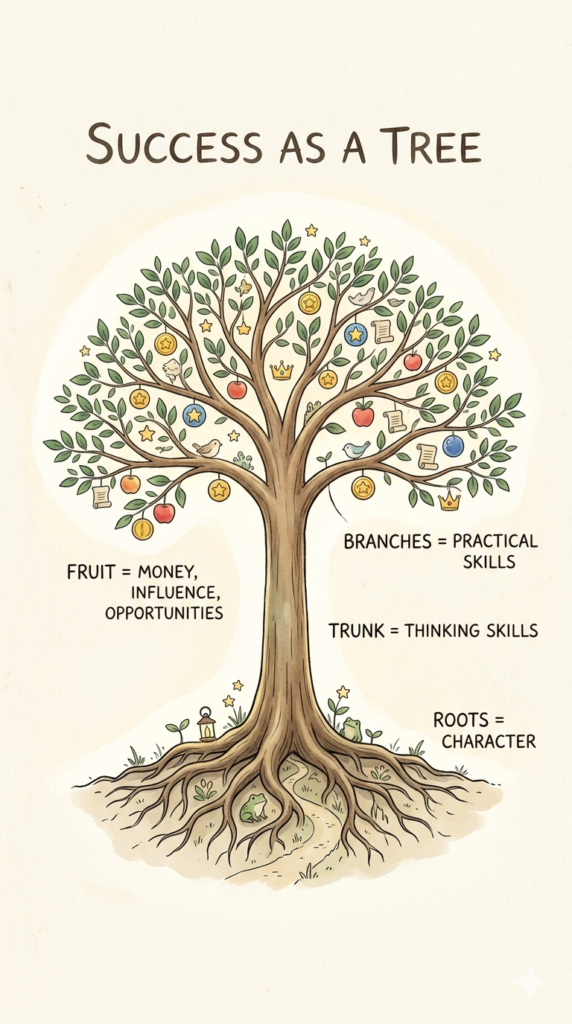
Most people chase the fruit. They obsess over salary packages, follower counts, and business revenue — while neglecting the roots. And when the storm comes (a recession, a layoff, a market shift), the tree falls
The people who remain standing are those who built deep roots first.
Layer 1: Character — The Foundation Everything Else Rests On
Integrity
Warren Buffett famously said he looks for three things when hiring: intelligence, energy, and integrity — and if someone lacks the third, the first two will destroy you.
Integrity is doing what you believe is right even when it costs you. It builds trust. Trust creates access. Access creates opportunities. Opportunities create wealth.
This is not a soft observation. A 2016 study published in the Journal of Applied Psychology found that perceived integrity in leaders significantly predicted team performance and organizational commitment — far more than technical skill.
Discipline
The psychologist Angela Duckworth spent years studying high performers — West Point cadets, national spelling bee champions, teachers in tough schools. Her finding, detailed in her book Grit, was striking: talent alone does not predict success. The quality that did? The ability to keep going when motivation fails.
Discipline is the ability to act without motivation.
The chain is simple: Discipline → Consistency → Competence → Results.
Delayed Gratification
In the now-famous Stanford Marshmallow Experiment (Walter Mischel, 1972), children who were able to wait for a second marshmallow instead of eating the first one immediately grew up to have higher SAT scores, better social functioning, and lower rates of substance abuse.
Choosing SQL today over Netflix tonight. Investing money instead of spending it. Writing one article instead of scrolling for an hour. These micro-decisions, made consistently, change a life.
Layer 2: Thinking Skills — The Highest-Leverage Layer
This is where most people have the biggest gap — and where the biggest returns are hiding.
First-Principles Thinking
Elon Musk has spoken extensively about this approach. When SpaceX was founded, rocket components were absurdly expensive. Instead of asking “how can we buy rockets cheaper?” — Musk asked: “What is a rocket made of? What do those raw materials actually cost?”
The answer revealed that rockets could be built for roughly 2% of the market price. SpaceX now routinely lands rockets and reuses them. That outcome was only possible because someone refused to accept the inherited assumptions of an industry.
First-principles thinking prevents blind imitation. Instead of asking “what do others do?” it asks “what is fundamentally true?”
Systems Thinking
Peter Senge‘s landmark book The Fifth Discipline introduced this idea to the business world: you cannot understand a system by looking at its parts in isolation. You must understand the relationships between the parts.
Most people think linearly:
Job → Salary
Systems thinkers see the full picture:
Skills → Reputation → Network → Opportunities → Income → Reinvestment → Larger Platform
Charlie Munger — Warren Buffett‘s partner at Berkshire Hathaway — built his entire mental framework around what he called “latticework of mental models.” He consistently attributed Berkshire’s success not to stock-picking, but to better thinking systems.
Decision Making
Jeff Bezos popularized a framework he calls “Type 1 vs Type 2 decisions.” Type 1 decisions are irreversible and consequential — they require deep deliberation. Type 2 decisions are reversible — they require speed, not perfection.
Most people agonize equally over both kinds. The result: slow on small decisions, impulsive on large ones.
A few good decisions — where to work, who to marry, which business to start, which friendships to cultivate — can compound positively for decades. The research backs this: a 2010 paper in Psychological Science found that high-quality decision-making was a stronger predictor of life outcomes than IQ.
Probabilistic Thinking
Annie Duke, a World Series of Poker champion who later became a decision coach for Wall Street firms, wrote Thinking in Bets — a book that argues most decisions are not about certainty, but about managing probabilities.
Instead of “I will succeed,” ask: “What actions increase my probability of success?”
This is how investors like Ray Dalio think. In Principles, Dalio describes building Bridgewater (the world’s largest hedge fund) around the idea that no one is ever certain — but some people are more right, more often, because they think probabilistically and update their beliefs with evidence.
Layer 3: Communication — Money Follows Value, Value Follows Communication
Writing
“Writing is thinking,” said mathematician and author William Zinsser. It clarifies your ideas to yourself before it communicates them to anyone else.
Paul Graham, founder of Y Combinator, has said he evaluates potential founders partly by how clearly they write. “Writing ability,” he argues, correlates directly with clarity of thought — and clarity of thought is what separates great founders from mediocre ones.
Every knowledge worker who wants to be taken seriously needs to write. Articles, emails, proposals, documentation — these are the mediums through which modern influence travels.
Speaking
Steve Jobs was not born a great communicator. His early presentations were disorganized and nervous. What changed? Deliberate practice over decades. By the time he returned to Apple in 1997, his keynote presentations were so carefully crafted that they were studied like performances.
Communication coach Carmine Gallo analyzed Jobs’ presentation techniques in The Presentation Secrets of Steve Jobs and found a consistent set of patterns: clarity, contrast, stories, demos, and passion. All learnable. All practiced.
Storytelling
Chip and Dan Heath, in their book Made to Stick, ran a simple experiment: MBA students were asked to make a one-minute persuasive speech. When surveyed afterward, audiences remembered the stories 63% of the time — but only 5% of the time remembered statistics alone.
Facts inform. Stories persuade. Many average ideas have succeeded because they were wrapped in a compelling narrative. Many brilliant ideas have died because they were communicated as spreadsheets.
Layer 4: Wealth Skills — The Direct Financial Levers
Sales
Zig Ziglar used to say: “Nothing happens until somebody sells something.”
Sales is the most under-respected skill in education and the most over-rewarded skill in the market. Every job interview is a sale. Every pitch to a client is a sale. Every YouTube thumbnail is a sale. Every email subject line is a sale.
The Bureau of Labor Statistics consistently shows that top-performing salespeople rank among the highest earners in virtually every industry — not because sales is glamorous, but because it is the direct mechanism through which value is converted into revenue.
Marketing
Seth Godin draws the distinction clearly: sales is convincing one person; marketing is building a system that attracts many people over time.
Apple’s “1984” Super Bowl ad didn’t just launch the Macintosh — it established a brand identity (rebels vs. conformists) that Apple has monetized for four decades. The product was important. The marketing was transformational.
Financial Literacy
Robert Kiyosaki‘s Rich Dad Poor Dad introduced millions to a foundational distinction: assets put money in your pocket; liabilities take money out. Most people spend their lives buying liabilities — cars, clothes, subscriptions — while calling them assets.
A 2021 S&P global survey found that only 33% of adults could correctly answer basic questions about compound interest, inflation, and risk diversification. The people who understand these concepts do not just earn more — they keep and multiply more.
Negotiation
A Harvard Business Review analysis estimated that the average professional loses over $1 million in lifetime earnings by not negotiating salary — often because they are uncomfortable asking. One well-handled salary negotiation, repeated at each career transition, can compound into life-changing wealth.
Layer 5: Modern Economic Skills — What the Market Pays For Right Now
Data Literacy
IBM estimated in 2020 that 2.5 quintillion bytes of data are created every day. Every company is now, at some level, a data company. The people who can collect, clean, analyze, and communicate data are disproportionately valuable.
The toolkit: Excel, SQL, Power BI, Python, and basic statistics. These are not advanced programming skills — they are the new spreadsheet literacy. Twenty years ago, knowing Excel was a competitive advantage. Today it is a baseline. Knowing SQL and Power BI is where the edge currently lives.
AI Literacy
A 2023 McKinsey Global Survey found that AI adoption had more than doubled since 2017, and that companies with the highest AI maturity reported significantly better financial performance than their peers.
The skill is not building AI. It is understanding how to work with AI tools, automate repetitive workflows, write effective prompts, and integrate AI into existing processes. This is the literacy of the next decade — in the same way that internet literacy was the literacy of the 2000s.
Digital Content Creation
Mr Beast grew a YouTube channel to 200+ million subscribers not because he had unique access or a wealthy background — but because he studied how content works, tested obsessively, and reinvested everything into the next video.
Content creates audience. Audience creates authority. Authority creates opportunities and business leads. A well-built personal brand compounds quietly for years before it pays off dramatically.
Layer 6: Human Skills — Where Smart People Quietly Fail
Emotional Intelligence
Daniel Goleman’s landmark 1995 book Emotional Intelligence introduced a finding that surprised many: IQ predicted career success up to a point, but emotional intelligence — understanding your own emotions and others’ — predicted who rose to the top.
A meta-analysis published in the Journal of Organizational Behavior (2010) confirmed that EQ was a stronger predictor of leadership effectiveness than cognitive intelligence in most organizational contexts.
People make decisions emotionally and justify them logically. Knowing this is a superpower.
Relationship Building
Reid Hoffman, co-founder of LinkedIn, wrote in The Start-Up of You: “The fastest way to change yourself is to hang out with people who are already the way you want to be.”
Opportunities flow through people. A warm introduction from the right person can accomplish in a day what months of cold outreach cannot. Investment in relationships — genuine, generous, long-term investment — has among the highest compounding returns of any activity in a career.
Leadership
Leadership is not a job title. It is the ability to help people move toward a shared goal.
Nelson Mandela led a movement from prison. Malala Yousafzai became a global leader for education at 15. Neither of them held formal authority when they began. What they had was clarity of purpose and the ability to bring others along.
The Compounding System
Notice how these layers connect:
Systems Thinking
       ↓
Better Decisions
       ↓
Data Analytics
       ↓
Business Insight
       ↓
Communication
       ↓
Influence
       ↓
Sales & Marketing
       ↓
Income
       ↓
Leadership
       ↓
Larger Opportunities
This is not a linear path. Each element strengthens the others. A person who thinks in systems makes better decisions. Better decisions produce better results. Better results give you something worth communicating. Good communication builds influence. Influence enables sales. Sales create income. Income enables reinvestment in people and systems. And the cycle expands.
Where to Start — No Matter Where You Are
The Success Stack is not a checklist to complete from top to bottom. It is a framework for diagnosing where you are and deciding what to build next.
Here is how to use it depending on your starting point:
If You Are Starting from Scratch
You have no established career, no strong network, and no specialized skill yet. The temptation is to start with the most marketable-sounding skill. Resist it.
Start with the roots:
- Discipline first. Nothing else works without it. Build one consistent habit — study one hour daily, write one page, exercise three times a week. Prove to yourself you can sustain something before you scale it.
- Pick one thinking skill. Systems thinking is the highest-leverage starting point. Read Thinking in Systems by Donella Meadows. It will change how you see everything else.
- Pick one modern economic skill. Data literacy (Excel → SQL → Power BI) is accessible, in high demand, and teaches you to think analytically. AI literacy is the other strong choice. Either one will pay for itself within a year.
- Start writing. A journal, a blog, a newsletter — it does not matter. Writing is the cheapest way to sharpen your thinking and begin building a visible track record.
You do not need to do everything at once. Four focused skills, practised consistently, will outperform twenty skills touched briefly.
If You Already Have Some Skills
You have experience — maybe a career, a business, a set of technical abilities — but you feel stuck, underpaid, or like you have hit a ceiling.
The ceiling is almost always in one of these places:
- Communication. You know more than you can express. People underestimate your value because you cannot yet transfer it through words, presentations, or writing. Fix this first.
- Sales. You are waiting to be discovered. You are doing excellent work in a room with the lights off. Learning to sell your ideas — internally at work, externally to clients or audiences — removes the ceiling faster than any technical upgrade.
- Network and relationships. You are working hard in isolation. The market does not always reward the best; it rewards the best-known. Invest in visibility and genuine relationships.
- Financial literacy. You are earning but not building. Understanding how to convert income into assets is the difference between high-earning and wealth-building.
Identify which of these is your weakest link. That is your highest-leverage investment right now.
If You Are Already Skilled and Successful
You have reached a level of competence and income. Growth from here is not about adding more skills — it is about multiplying through others.
The next frontier is always:
- Leadership. You have built individual excellence. Now build team excellence. The leverage of one great leader multiplying through ten, twenty, or a hundred people is incomparable.
- Systems. Can your work function without you? If not, you have built a job, not a business or a platform. The goal is to encode your thinking into systems — processes, content, tools, teams — that work while you sleep.
- Mentorship and teaching. The best way to consolidate mastery is to teach it. Richard Feynman called this the most reliable test of understanding: if you cannot explain it simply, you do not yet understand it fully. Teaching also builds reputation and network simultaneously.
The Universal Priority Order
Regardless of where you start, these seven capabilities have the highest cross-context return:
- Systems Thinking — see the whole board, not just the next move
- Communication (Writing + Speaking) — the multiplier on every other skill
- Sales — the mechanism through which value becomes income
- Financial Literacy — so you build, not just earn
- Data Literacy — the language of modern decision-making
- AI & Automation — the baseline skill of the next decade
- Leadership — the shift from individual to exponential
These are not ranked by importance alone — they are ranked by sequence. Thinking skills make everything else more effective. Communication makes thinking visible. Sales converts value into reward. Financial literacy preserves and grows the reward. Data and AI give you leverage in the modern economy. Leadership multiplies all of it through people.
You do not need to master all seven before you start seeing results. Pick the one that is most obviously missing from your current situation. Work on it for six months. Then pick the next one. The compounding happens slowly, then all at once.
The Deepest Pattern
Money is not at the center of the system. It never is for the people who end up with the most of it.
The deepest pattern among exceptionally successful people — across industries, countries, and centuries — is this:
They became unusually good at creating value, communicating value, and multiplying value through people and systems. Money followed as a consequence.
The roots come first. The fruit comes last. But it comes.
This article is part of an ongoing series on building skills that compound — for people who want to build careers, businesses, and lives that last.