
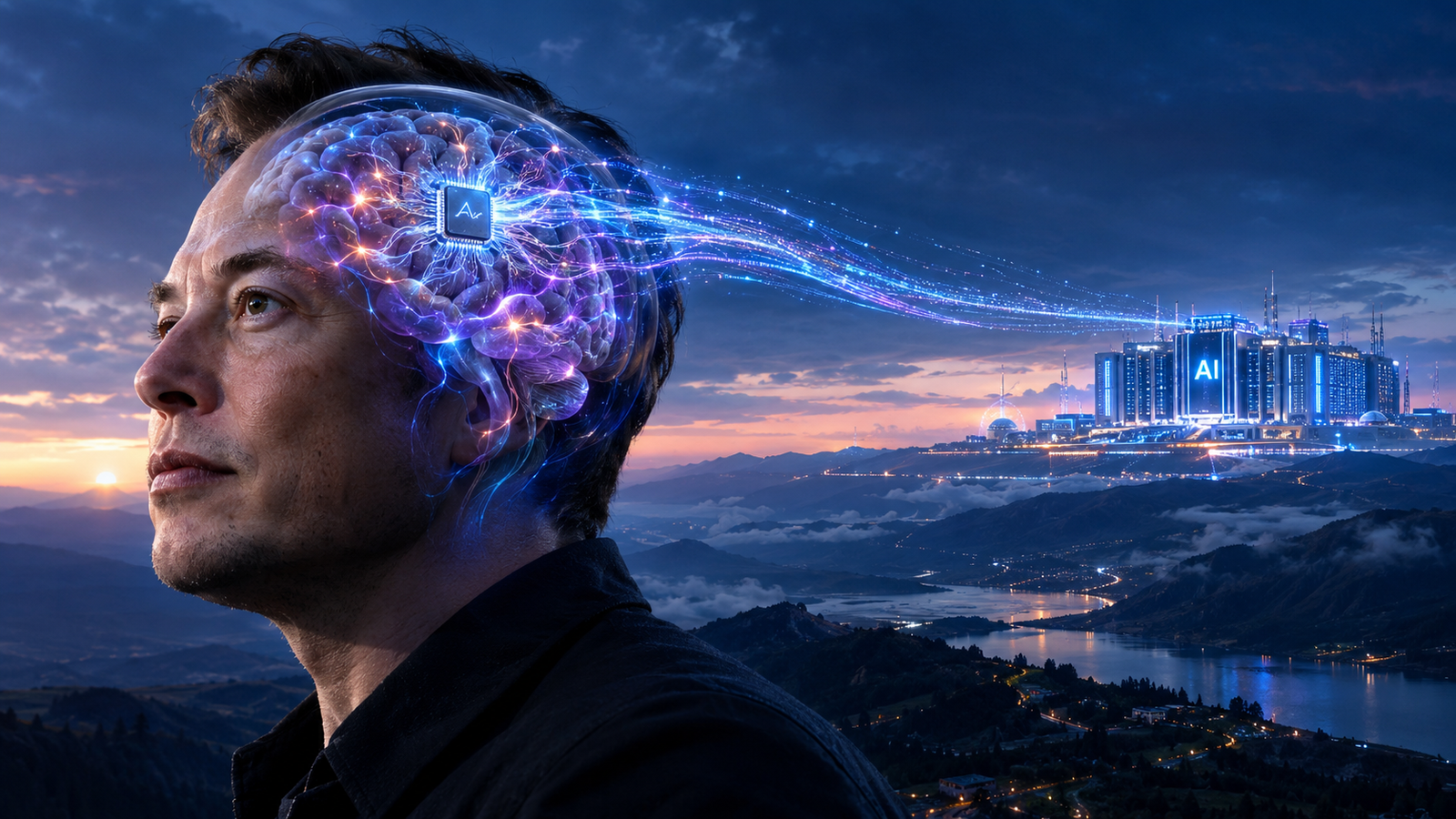

What happens when the distance between thought and technology disappears?
For decades, computing has followed a remarkably consistent trajectory.
We moved from rooms filled with machines to desktop computers. From desktops to laptops. From laptops to smartphones. From smartphones to watches, earbuds and other increasingly intimate devices.
Each transition removed another layer of friction between the human being and the machine.
The next transition could be considerably more consequential.
What if the computer itself no longer needed to be outside us?
Imagine a future in which you do not reach for your laptop to write an article. You do not unlock your phone to search the internet. You do not open Google Maps to find a destination. You simply form an intention in your mind—and a computer interprets it.
The answer appears through a neural interface.
The map becomes something you experience rather than something you look at.
The distinction between thinking and commanding a computer begins to disappear.
This is the territory of the brain-computer interface (BCI), sometimes called a brain-machine interface (BMI).
And although the fully integrated future remains speculative, the underlying technology is no longer science fiction.
We Have Already Begun Connecting Brains to Computers
The most visible company in this field is Neuralink, founded by Elon Musk.
Neuralink’s current work is principally medical. Its PRIME study is investigating an implanted device called the N1, designed to record neural activity and allow people with paralysis to control external computers. The implant contains 1,024 electrodes distributed across 64 flexible threads, which are surgically positioned in a region of the brain associated with movement intention.
Neuralink’s own clinical-trial materials describe the system as an investigational technology rather than a commercially available consumer product.
Nevertheless, the demonstrations are extraordinary.
Neuralink reports that participants have used its devices to control computers and robotic arms through neural signals. As of January 2026, Reuters reported that Neuralink had enrolled 21 participants in human trials worldwide. Its first participant had used the implant for activities including controlling a computer cursor, playing games and browsing the internet.
And Neuralink is not alone.
Synchron
Synchron has taken a different approach.
Instead of opening the skull and placing electrodes directly into brain tissue, Synchron’s Stentrode is delivered through blood vessels near the brain’s motor cortex. In its COMMAND study, six people with severe paralysis were followed for 12 months, with the company reporting no serious device-related adverse events and continued ability to translate motor intentions into digital commands.
Earlier work with Synchron’s system demonstrated control of digital tasks including text messaging, email, shopping and other computer functions.
Blackrock and the wider BCI field
Researchers using Blackrock Neurotech technology have demonstrated increasingly sophisticated control.
In one 2025 demonstration, a person with paralysis controlled a virtual quadcopter using neural signals corresponding to multiple finger movements. The system achieved four degrees of freedom and an average target-acquisition rate of 76 targets per minute.
Other researchers have demonstrated something even more profound: decoding attempted speech.
A 2026 Nature Medicine study described long-term independent use of an intracortical BCI for speech and cursor control in a participant with ALS. The system enabled communication and computer interaction through neural signals rather than conventional muscular movement.
These achievements do not mean that we have created a machine capable of reading every thought.
We have not.
But they demonstrate something fundamental:
specific patterns of neural activity can be measured, interpreted and translated into useful digital actions.
That is the crucial technological breakthrough.
So, What Exactly Is a Brain-Computer Interface?
The simplest way to understand a BCI is to imagine a translator.
Your brain produces electrical and chemical activity.
When you intend to move your hand, speak, reach for something or perform another action, particular patterns of neural activity occur.
A BCI attempts to capture some of those patterns and translate them into commands.
Conceptually:
Intention → Neural activity → Neural recording → Algorithm → Digital command → Action
You think about moving a cursor.
Your brain produces a pattern.
Electrodes detect aspects of that pattern.
Machine-learning algorithms interpret it.
The computer moves the cursor.
The remarkable part is not that the computer understands English or understands your thoughts in the ordinary sense.
It is that the system learns a relationship between neural patterns and intended actions.
Current BCIs therefore remain much narrower than the popular imagination suggests.
They do not simply download the contents of a person’s mind.
They decode particular neural signals associated with particular tasks.
That distinction matters enormously.
From Controlling a Computer to Becoming the Computer Interface
Now imagine extending the technology.
Today:
Brain → BCI → Computer → Screen → Human
The computer remains outside you.
You must look at a screen.
You must interpret what is displayed.
You must move through menus.
You must physically interact with a device.
But suppose future systems become sufficiently sophisticated that the interface itself becomes almost invisible.
Then we could imagine:
Brain → AI → Brain
The laptop becomes optional.
The smartphone becomes optional.
Perhaps even the graphical user interface becomes optional.
You might think:
“Find the fastest route to this location.”
The AI computes the route.
You receive the relevant information through a neural interface.
No screen.
No keyboard.
No touchscreen.
No search engine interface.
No application.
Only intention and response.
That is a radically different conception of computing.
The Ultimate Personal Assistant May Be Inside Your Head
Consider what today’s smartphone actually does.
It remembers things.
It searches.
It calculates.
It translates.
It navigates.
It communicates.
It stores information.
It recommends.
It connects you to other people.
Artificial intelligence has already begun consolidating many of these functions into a single conversational interface.
Now imagine combining AI with a sufficiently advanced BCI.
A healthy person could theoretically possess an always-available computational layer connected directly to their nervous system.
You might ask yourself:
What is the capital of Kazakhstan?
You receive the answer.
You wonder:
What was the name of that book I read three years ago?
The system retrieves it.
You are travelling:
How long until I reach my destination?
The information becomes available without reaching for a phone.
You are writing:
What is the clearest way to express this idea?
The AI assists.
You are learning mathematics:
Show me why this equation works.
The system provides an explanation.
The boundary between using a computer and using your own cognition begins to blur.
This is where the idea becomes much more interesting than simply replacing keyboards.
It potentially changes our relationship with knowledge itself.
But There Is a Crucial Distinction: Information Is Not Intelligence
Suppose, hypothetically, that you could access the entire internet through your brain.
Would you therefore become intelligent?
Not necessarily.
A library does not become intelligent because it contains millions of books.
Likewise, possessing instant access to information does not automatically produce understanding.
You could know the answer without understanding the question.
You could retrieve a historical fact without understanding its significance.
You could generate an argument without recognising whether the premises are sound.
You could calculate the optimal route without knowing whether taking that route is morally appropriate.
And this brings us to a distinction that may become increasingly important in an AI-saturated world:
Information is not knowledge.
Knowledge is not understanding.
Understanding is not wisdom.
What Happens to Education?
This could be one of the greatest questions raised by brain-computer interfaces.
For centuries, education has partly been an exercise in acquiring information.
We memorise vocabulary.
We learn mathematical procedures.
We study historical dates.
We learn scientific principles.
We practise writing.
We learn how to retrieve and manipulate knowledge.
But what happens when information retrieval becomes almost instantaneous?
If a person can access an AI system directly through a neural interface, does memorisation remain as important?
Perhaps less so.
But that does not necessarily make education obsolete.
It may make good education more important.
The educational objective could shift from:
“What do you know?”
towards:
“What can you understand?”
And eventually:
“What can you judge?”
A student might no longer need to memorise every fact.
But the student would still need to understand causality.
Logic.
Scientific reasoning.
History.
Human behaviour.
Ethics.
Trade-offs.
Probability.
Philosophy.
And perhaps most importantly, how to ask the right question.
The paradox is fascinating:
When machines become better at providing answers, humans may need to become better at formulating questions.
Will We Still Need to Learn Anything?
Imagine a student in 2050.
She has access to an AI system connected directly to her brain.
Why should she spend years learning calculus if the system can solve any equation?
Why memorise geography if every location is immediately available?
Why learn another language if instantaneous translation is possible?
Why remember historical facts if an AI can retrieve them in milliseconds?
These are not merely educational questions.
They are questions about what it means to develop a human being.
Perhaps education will gradually move away from storage and toward structure.
The goal may become less about filling the mind with information and more about constructing a mind capable of:
- reasoning;
- questioning;
- synthesising;
- creating;
- judging;
- empathising;
- resisting manipulation;
- understanding consequences;
- and distinguishing truth from persuasive nonsense.
A calculator did not make mathematics meaningless.
The internet did not make knowledge meaningless.
Generative AI has not made thinking meaningless.
They changed which parts of thinking became scarce.
BCIs could accelerate that transformation dramatically.
Will the Meaning of Knowledge Change?
For most of human history, knowledge had a physical and cognitive cost.
You had to travel to a library.
You had to find a book.
You had to read it.
You had to remember it.
You had to retrieve it later.
Digital technology progressively reduced that cost.
Google reduced the cost of retrieval.
Smartphones reduced the cost of access.
AI is reducing the cost of synthesis.
A sufficiently advanced BCI could reduce the friction between human intention and computational capability almost to zero.
At that point, the economic value of simply possessing information may decline further.
The scarce resource may instead become judgement.
Everyone could have access to extraordinary amounts of information.
But not everyone would know:
- which information matters;
- which information is false;
- which trade-off is acceptable;
- which objective is worth pursuing;
- and what should never be done merely because it can be done.
Knowledge could become abundant.
Wisdom could become scarce.
And What About Wisdom?
This may be the most important question of all.
A machine can potentially tell you what happened.
It can explain why something happened.
It may eventually predict what is likely to happen.
But should you do something?
That is a different question.
Wisdom is not simply the accumulation of correct answers.
It involves judgement under uncertainty.
It involves values.
It involves restraint.
It involves understanding human beings.
It involves knowing when not to act.
Imagine two people with exactly the same neural access to an extraordinarily powerful AI.
One uses it to understand people, create medicines, solve problems and serve society.
The other uses it for manipulation, exploitation and domination.
The technology is identical.
The outcomes are not.
The difference lies partly in the person.
This is why the future of brain-computer interfaces cannot be discussed solely as an engineering problem.
It is also a philosophical problem.
And ultimately, a moral one.
The Risks Begin Where the Possibilities Become Most Exciting
The prospect of connecting the human brain directly to computers is extraordinary.
It is also unprecedented.
A smartphone can be reset.
A laptop can be replaced.
A password can be changed.
But what happens when the device that stores or processes your most intimate neural signals is implanted inside your body?
The risk landscape changes fundamentally.
1. Neural Data Privacy
Your search history is sensitive.
Your photographs are sensitive.
Your location history is sensitive.
But neural data could potentially be more intimate still.
As BCIs become more capable, researchers and ethicists have raised concerns about the privacy and security of neural information, including questions about who controls it, how it can be used, and whether it could reveal information about a person’s mental states or intentions.
Imagine a future in which corporations possess detailed records of your interactions with an AI through your brain.
Who owns that data?
You?
The device manufacturer?
The AI company?
A hospital?
An employer?
Could insurers demand access?
Could governments?
Could advertisers?
And what happens if someone hacks the system?
Cybersecurity would no longer concern only your bank account or photographs.
It could concern the most intimate technological boundary imaginable:
your mind.
2. What If the Technology Damages the Brain?
An invasive BCI requires a physical interface with neural tissue.
That introduces medical risks.
Research on invasive BCIs has identified concerns including infection, tissue damage, foreign-body reactions and scar-tissue formation around implanted electrodes. Long-term performance is also a major scientific question.
Some research is encouraging. For example, long-term work with intracortical stimulation has demonstrated years of functionality in small numbers of participants. But these studies remain early clinical research, not evidence that invasive BCIs are yet suitable for healthy people seeking general cognitive enhancement.
This distinction is critical.
A technology that may be justified when restoring communication to someone who has lost the ability to speak is not automatically justified for a healthy person who simply wants faster access to information.
The risk-benefit equation changes.
3. Could It Affect IQ or Cognitive Function?
This question deserves intellectual caution.
There is currently no basis for claiming that installing a BCI will simply make someone “smarter” or reduce their IQ.
The more interesting question is different:
What happens to cognition when a person becomes deeply dependent on an external computational system?
We already know what happens when humans outsource certain cognitive tasks to technology: some abilities can become less practised, while others become more important.
A BCI could potentially extend this phenomenon dramatically.
If an AI can always retrieve information, will memory become less important?
If an AI can always calculate, will mental arithmetic decline?
If an AI can always generate arguments, will independent reasoning weaken?
These are empirical questions that require evidence.
But they are worth asking before the technology becomes ubiquitous.
Researchers studying BCIs for cognitive enhancement have already raised questions concerning safety, autonomy, privacy, inequality and possible changes to human cognition and identity.
4. What Happens to Human Autonomy?
There is another danger that is more subtle than hacking.
Dependence.
Imagine an AI that is so deeply integrated into your cognitive life that you no longer know where your own judgement ends and the machine’s recommendation begins.
If the system suggests an action, did you decide?
What if the system is wrong?
What if the algorithm has been trained on biased information?
What if the company changes the system?
What if the service is discontinued?
An ordinary software subscription can be cancelled.
But if the technology becomes deeply embedded in a person’s cognitive life, discontinuation could become something closer to dependency.
Researchers have therefore discussed autonomy, responsibility, identity and the possibility of “hyperagency” alongside the potential benefits of enhancement BCIs.
The central question becomes:
Are we building a tool that extends human agency—or a system that gradually becomes part of the mechanism through which agency is exercised?
5. Could BCIs Create a New Class Divide?
There is also an economic question.
Suppose a future BCI genuinely provides significant cognitive advantages.
Who gets it first?
People with money.
People with access to advanced healthcare.
People in technologically sophisticated societies.
People whose employers can afford it.
People willing to accept the risks.
This could produce a new form of inequality.
Not merely inequality of wealth.
Inequality of cognitive access.
A person without the technology might be competing for a job against someone who can interact directly with powerful AI systems at the speed of thought.
Researchers have already identified socioeconomic inequality as one of the ethical concerns surrounding cognitive-enhancement BCIs.
The question would then become much larger than:
“Should I get a BCI?”
It would become:
“What happens when society starts expecting everyone to have one?”
The Most Important Question May Not Be Technological
We are accustomed to asking:
Can we build it?
But that is not the only question.
We should also ask:
Should we build it?
And even that is insufficient.
We should ask:
Under what conditions should we build it?
For whom?
With whose consent?
Who owns the data?
Who is liable when the system fails?
Can a person remove the implant without losing essential capabilities?
Can a company modify the software after implantation?
Can neural data be sold?
Can employers require BCI use?
Can governments access neural information?
Can a child meaningfully consent to permanent cognitive augmentation?
And perhaps the deepest question:
What parts of human limitation are problems to be solved—and what parts are constitutive of being human?
Perhaps the Laptop Was Never the Real Problem
There is a temptation to think of technological progress as a race to eliminate physical interfaces.
Keyboard → touchscreen → voice → thought.
But perhaps the deeper story is not about removing the laptop.
It is about removing friction between human intention and computational capability.
That could be extraordinary.
A person who has lost the ability to move could communicate.
A person who cannot speak could potentially recover a means of expression.
A person with severe paralysis could control a computer.
A prosthetic limb could respond more naturally to intention.
And, eventually, perhaps healthy people could use neural interfaces to augment how they interact with information and machines.
These possibilities deserve serious scientific exploration.
But the technology should remain subordinate to the human being—not the other way around.
The Future May Not Belong to People Who Know the Most
For thousands of years, human civilisation rewarded people who could accumulate knowledge.
Then computers arrived and became extraordinarily good at storing it.
The internet made information almost universally accessible.
Artificial intelligence is becoming increasingly capable of transforming information into answers.
Brain-computer interfaces may eventually make the interface itself almost invisible.
If that trajectory continues, something fascinating could happen.
Knowledge may become increasingly abundant while wisdom remains scarce.
The person of the future may not be distinguished by how much information he can store in his mind.
He may be distinguished by what he does with the information available to him.
He may need more judgement, not less.
More character, not less.
More intellectual discipline, not less.
More ethical clarity, not less.
Because when intelligence becomes cheap and abundant, the quality of the person directing that intelligence becomes more important.
The Real Revolution Is Not Putting a Computer in the Brain
The spectacular image is a human being with a computer implanted inside the skull.
But that is not the deepest transformation.
The deeper transformation would occur when the distinction between human cognition and machine computation becomes increasingly porous.
At that point, humanity would face a question far more profound than whether laptops have become obsolete.
We would have to decide what we want to preserve about being human.
Perhaps we will eventually be able to access almost any fact instantly.
Perhaps AI will become an extension of memory.
Perhaps computation will become an extension of thought.
Perhaps communication will become an extension of intention.
But none of these developments answers the oldest human questions.
What is worth knowing?
What is worth creating?
What is worth pursuing?
What should we refuse to do?
And ultimately:
What kind of human being should we become when technology gives us unprecedented power?
That is the question that may matter most.
The future of computing may indeed move from our hands to our brains.
But the future of humanity will still depend on something technology cannot simply install:
wisdom.